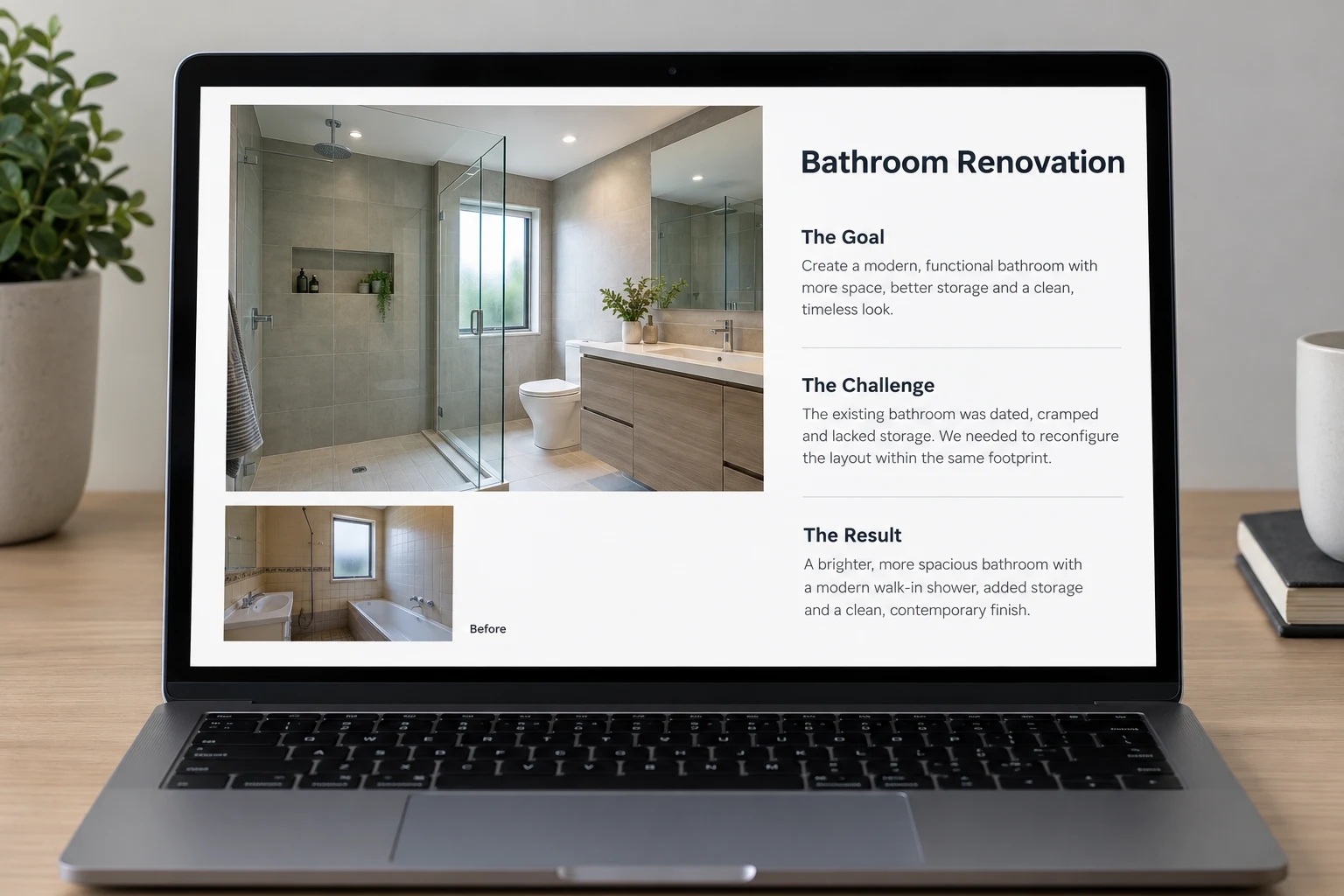
A finished kitchen tells a homeowner that you can produce a finished kitchen.
It may not tell them why they should hire you.
They can see the cabinets, countertops, and lighting. They can’t see the awkward layout you corrected, the problem you found behind the wall, or the planning that kept a small room usable.
Those details are worth including. They help a prospective customer understand your contribution to the project.
Give each project a short explanation
Start with what the customer wanted.
“The homeowners wanted more storage without expanding the kitchen” gives the visitor a reason to look more closely at the photos.
Then explain the important decisions. Perhaps you changed the cabinet arrangement, moved an appliance, or kept the plumbing in place to protect the budget.
Finish with what the completed project accomplished.
A few useful paragraphs can do the job. You don’t need to turn every bathroom renovation into a lengthy case study.
Here’s a hypothetical example:
The homeowners liked their neighborhood but had outgrown the kitchen’s storage and work space. We kept the existing footprint and reorganized the layout around how they cooked. Full-height cabinets added storage, while relocating the refrigerator opened a clearer path through the room.
That gives the reader something the photograph alone cannot.
Choose photos that explain the work
Before-and-after photos are easier to understand when they’re taken from roughly the same position.
Include a wider view so people can understand the space. Add close-ups when they reveal something meaningful about the work.
Process photos can be useful, too. Protection around an occupied living area, preparation before an installation, or a detail that will eventually be concealed can help explain your standards.
Give each photo a caption that tells the visitor what to notice.
“New bathroom” adds very little. “The doorway was widened and the layout changed to create more room beside the shower” explains a decision.
Help visitors find relevant projects
Organize the gallery around how customers shop.
If you offer several services, let visitors find kitchens, bathrooms, additions, or decks separately. A homeowner shouldn’t have to open twenty unrelated projects to discover whether you’ve done work like theirs.
Use locations where appropriate and permitted, but protect customer privacy. Obtain permission for photos, identifying details, and testimonials.
Make the next conversation easier
At the end of a project page, invite the visitor to describe a similar need.
You might ask which part of their current space isn’t working or what they hope to accomplish.
That creates a more useful starting point than a general invitation to “contact us.”
For your next completed job, collect five things: the customer’s original goal, the main challenge, the approach you took, a few well-chosen photos, and an approved customer comment.
You’ll have material that helps someone understand why the work mattered—and whether your company might be right for their project.
Project photos and the story around them are part of my contractor website design and content work. A free homepage audit is a practical starting point if you’re unsure how well your site presents your work.