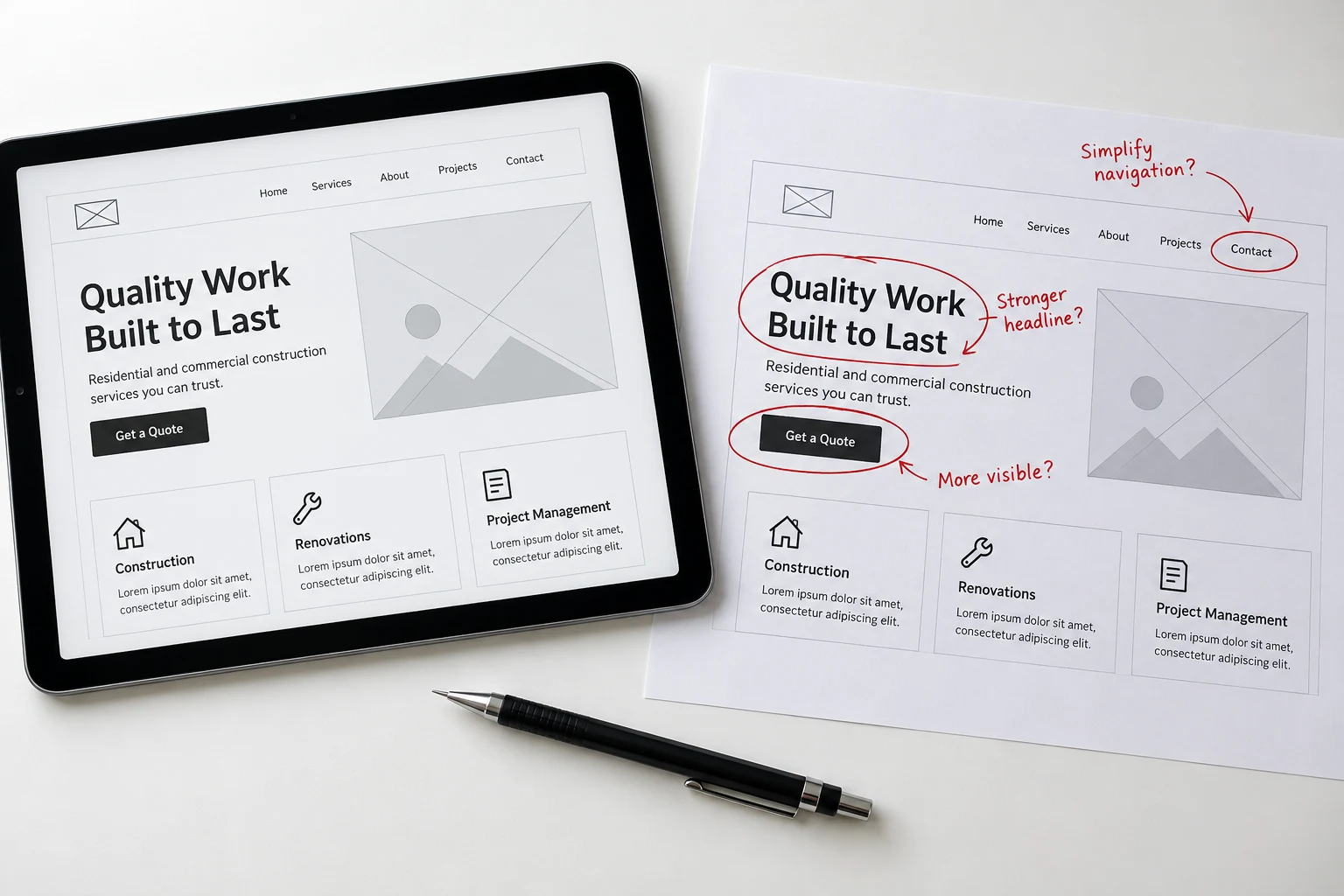
A website redesign should have a business reason behind it.
Being tired of looking at the same homepage isn’t much of one.
Before I’d recommend replacing a contractor’s website, I’d want to understand what’s failing. Sometimes a focused repair is the more sensible use of the budget.
The important question is whether the existing site can support what the business needs.
I’d start with the customer’s path
Can someone on a phone quickly understand what you do, where you work, and how to contact you?
Can they find examples of relevant projects? Does the contact form work? Is the phone number easy to tap? Are the service descriptions accurate?
If the site handles those basics reasonably well, we may have something worth improving.
A vague headline, outdated project gallery, confusing service page, or buried contact button can often be addressed individually.
For example, a remodeler’s homepage might say “Bringing Your Vision to Life” without explaining which projects the company takes on. Replacing that headline and improving the surrounding copy could be a useful first change.
It deserves consideration before commissioning an entirely new site.
I’d look at what you can maintain
A website needs to keep up with the business.
You should be able to update project photos, revise service information, and correct ordinary details without turning every change into an expensive production.
If the current system allows that, it has value.
If routine edits are difficult, the layout breaks on phones, and every improvement creates another problem, a rebuild becomes easier to justify.
The same applies when the business has changed substantially. A site created for small repair work may need significant restructuring if the company now specializes in major renovations.
I’d compare the full scope of both options
A low repair estimate can be misleading if it only addresses the first of several known problems.
Ask what the proposed work will accomplish and what will still need attention afterward.
Then ask the same questions about a rebuild. A new design can still leave you with weak copy, poor project information, or a difficult inquiry process.
The proposal should explain how the work supports the business, including who will provide the content and how existing URLs and inquiries will be handled during a transition.
I’d establish a baseline
Before making substantial changes, record what you can: inquiries, booked consultations, common customer questions, and any known usability problems.
Confirm that measurement is working. A broken form and a broken tracking setup can both make a website look unproductive, but they require different fixes.
After the work, review whether the identified problems improved. Allow for other influences, including seasonality and changes in advertising.
My recommendation would depend on what we find. Some websites deserve to be replaced. Others need a better explanation of the business and a handful of practical corrections.
A homepage review is a useful place to begin. It gives us a chance to identify the problem before deciding how much website you need to buy.
For a broader look beyond the homepage, compare my written and video website audit packages before deciding what to change.